Everything You Need to Know About CNC Machines
A Comprehensive Overview of CNC Machines: Definition, Types, Advantages, and Applications
Nowadays, many businesses and manufacturing facilities apply CNC machines in production to optimize workflows, reduce labor and costs, while simultaneously improving accuracy and enhancing product quality. CNC technology was first developed in the late 1940s and early 1950s, and over the decades it has evolved into a wide variety of models and functions.
So, what exactly is a CNC machine? What are the most common types of CNC machines in use today? Let’s explore their structure, working principles, advantages, disadvantages, and applications.
What is a CNC Machine?
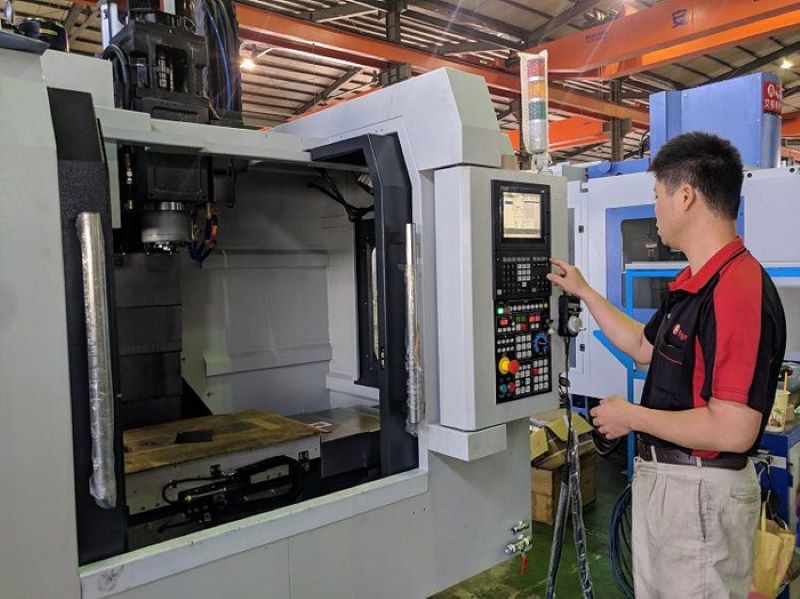
CNC (Computer Numerical Control) machines are widely used in mechanical processing industries. They are automated machine tools controlled by a computer system. Each component operates according to pre-programmed instructions to produce parts with precise shapes and dimensions that meet specific requirements.
Additionally, CNC cells—integrated systems of multiple CNC machines—allow multi-tasking on a single workpiece, enhancing flexibility in production and saving significant time.
Classification of CNC Machines
By Machine Tool Type
-
CNC Milling Machine: Capable of performing a wide range of cutting operations. The cutting tool can move linearly (X-Y axes), vertically (Z axis), along circular paths, or even in full 3D space. CNC milling machines execute milling, drilling, tapping, and boring with high accuracy (up to ±0.01mm). They can also be used for precision measurements.
-
CNC Lathe Machine: Designed for producing rotationally symmetric parts such as shafts, bushings, wheels, holes, and threads. Besides standard turning, CNC lathes can perform drilling, grooving, knurling, and polishing. The most common models are 2-axis and 4-axis CNC lathes, which allow fast and accurate cutting.
-
CNC Drilling Machine: Equipped with advanced control systems, these machines can perform milling, drilling, and measuring operations simultaneously with high precision. They are designed for continuous operation while maintaining product quality.
Other CNC machine tool types include CNC punching machines, boring machines, grinding machines, gear hobbing machines, planers, broaching machines, and CNC saws.
By Cutting Method
-
CNC Router: Used for cutting wood, plastics, composites, aluminum, and soft metals. It enables precise cutting of complex 2D and 3D shapes, optimizing workflow and saving costs.
-
CNC Plasma Cutting Machine: Uses a high-temperature plasma torch to cut electrically conductive materials such as steel and iron. Plasma CNC machines are widely applied in mechanical fabrication, with handheld, mini, and industrial models available.
-
CNC Laser Cutting Machine: Utilizes a high-energy laser beam focused through an optical system to cut metals, non-metals, and alloys. Fully automated, laser cutting ensures extremely high accuracy and meets strict machining standards.
Additional technologies include 3D Printing (Additive Manufacturing) and Multi-Axis CNC Machining, which provide greater flexibility and capability for producing complex geometries.
Structure and Working Principle of CNC Machines
Despite variations in design, most CNC machines consist of the following key components:
-
Motors: Provide motion for cutting and positioning. Common types are stepper motors (precise incremental motion) and servo motors (high-performance closed-loop motion control).
-
Controller Unit: The “brain” of the CNC system, receiving programmed commands, processing NC code, and transmitting signals to actuators and drives.
-
Rack and Guide Rails: Provide linear motion with high load-bearing capability, ensuring precise and stable movement of the machine.
Working Principle
CNC machines operate based on the Cartesian coordinate system (X, Y, Z axes).
-
The Z-axis controls the vertical motion of the cutting tool.
-
The X and Y axes move the workpiece along linear paths.
During machining, the cutting tool receives power from the spindle or energy source, penetrates the material, and follows programmed toolpaths to produce the final geometry.
Advantages and Disadvantages of CNC Machines
Advantages
-
Significantly higher productivity compared to manual machining
-
Easy parameter adjustment through computer interface
-
High cutting speeds thanks to modern drive systems
-
Near-perfect accuracy and repeatability, even for small details
-
Capable of machining a wide variety of materials
Disadvantages
-
High initial investment cost
-
Maintenance and repair expenses after warranty period
-
Requires skilled operators with knowledge of programming and computer systems
-
Can be challenging for beginners to operate effectively
Applications of CNC Machines
CNC machines are widely applied across industries, especially in mechanical engineering and manufacturing, for machining materials such as wood, stone, metals, stainless steel, and alloys. They play a crucial role in modern industrial production, from mass manufacturing to highly customized precision parts.